


What is Authentic Carbonara? The Truth Behind Italy’s Most Famous Pasta
- Medhat Awad

- Jun 11
- 12 min read
Updated: Jun 14
If you add a splash of heavy cream to your pasta, you aren't making carbonara; you're making a mistake that would break a Roman chef's heart. We know how tempting it is to reach for the dairy when you're worried about ending up with a bowl of scrambled eggs or can't find a block of sharp Pecorino Romano. Understanding what is authentic carbonara starts with appreciating that the most celebrated dish in Italy relies on chemistry and heritage rather than a long list of ingredients. It's a culinary hug in a bowl, born from the spirited streets of Rome and perfected through generations of passionate hospitality.
This article promises to demystify the process, showing you how to achieve that coveted, velvety creaminess through the art of emulsification. You'll learn why the five pillars of guanciale, eggs, cheese, pepper, and pasta are all you need for a masterpiece. We'll also give you the insider knowledge to spot an imitation on a menu from a mile away. Prepare to transform your kitchen into a scenic Italian trattoria as we uncover the soulful truth behind this iconic recipe.
Key Takeaways
Learn why a true Roman recipe relies on exactly five specific ingredients and why heavy cream is never part of the traditional equation.
Master the secret technique of emulsification to achieve a perfectly velvety sauce while avoiding the common trap of scrambled eggs.
Understand what is authentic carbonara by exploring the distinct fat profiles of guanciale and pancetta to elevate your home cooking.
Uncover the mysterious history of the dish, ranging from the legends of Italian charcoal burners to the influence of World War II rations.
Discover how the heritage of Rome meets the beauty of the Exeter Quayside through our signature Spaghetti Carbonara.
Table of Contents
The 5 Pillars: What are the Authentic Carbonara Ingredients?
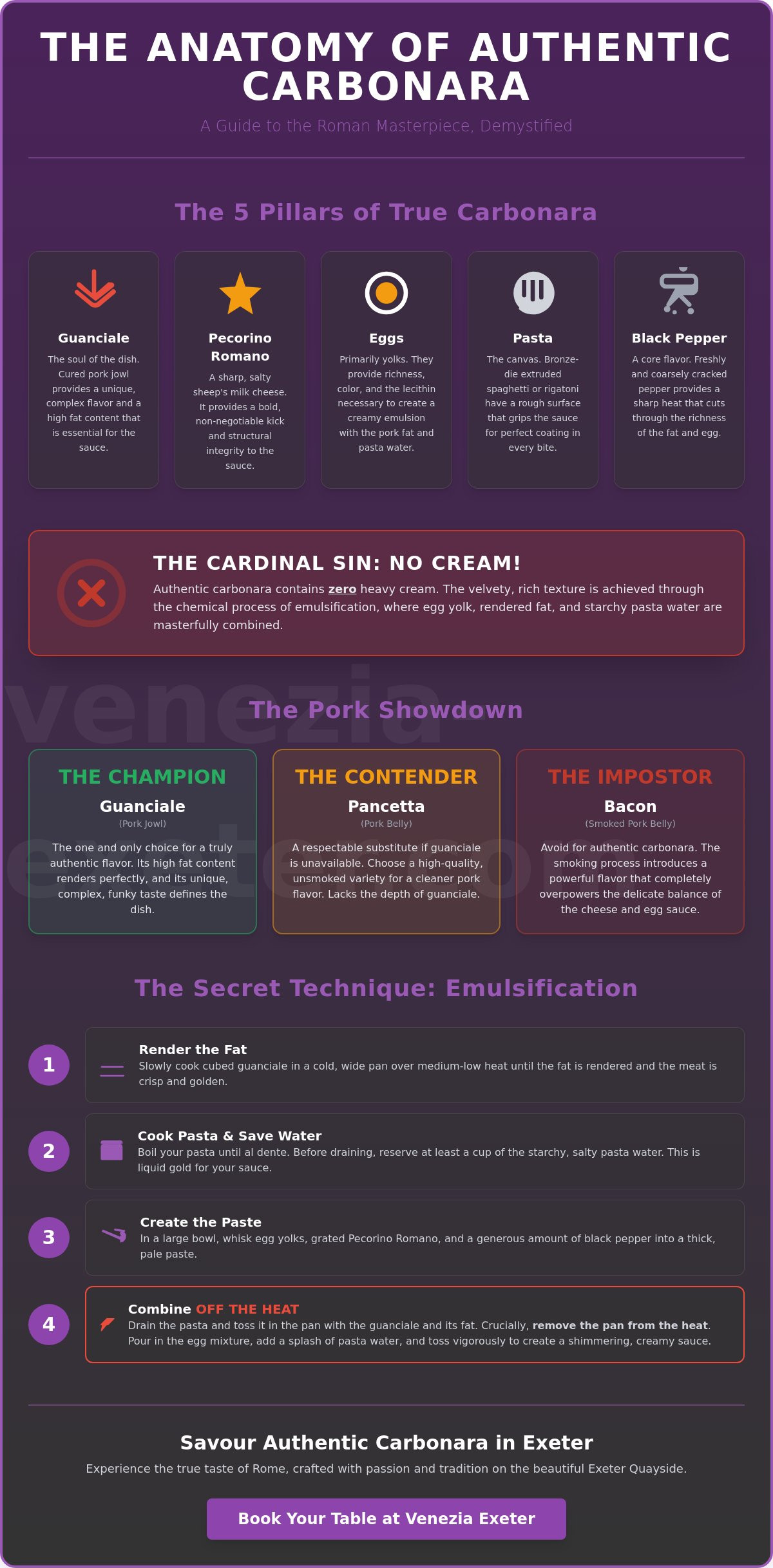
To truly grasp what is authentic carbonara, you must first understand its place within the "Holy Trinity" of Roman pasta. Along with its siblings, Gricia and Amatriciana, carbonara represents a minimalist philosophy where every ingredient has a vital role to play. There is a sacred rule in Italian kitchens that often surprises visitors: a traditional recipe contains exactly zero drops of heavy cream. The velvety texture that diners love doesn't come from a carton, but from the careful marriage of egg yolks and rendered pork fat.
High quality pasta is the canvas for this masterpiece. We always recommend bronze-die extruded spaghetti or rigatoni. These varieties have a rough, porous surface that acts like a magnet for the sauce, ensuring every strand is perfectly coated. Freshly cracked black pepper isn't just a finishing touch; it's a core flavour component. You need that sharp, toasted heat to cut through the richness of the eggs and pork. It provides a necessary counterpoint to the creamy emulsion. As you explore A History of Carbonara, you'll see how these humble pantry staples evolved into a global icon.
The Pork: Guanciale vs. Everything Else
Guanciale, or cured pork jowl, is the undisputed soul of the dish. Unlike belly-cut pancetta, guanciale boasts a higher fat-to-meat ratio and a deeper, herbal complexity from its curing process. This fat melts at a lower temperature, creating an unctuous base that defines the Roman character. It's seasoned with rosemary, garlic, and pepper, which infuses the entire plate with aroma. While many UK recipes suggest smoked bacon, it lacks the specific funky notes that make the dish sing. If you can't find guanciale, a high quality unsmoked pancetta is a respectable choice that provides a cleaner pork flavour.
The Cheese: Pecorino Romano and the Salt Factor
The sharp, salty kick of Pecorino Romano is non-negotiable for anyone asking what is authentic carbonara. This sheep's milk cheese provides a structural boldness that cow's milk cheeses simply can't match. Its high protein content and aging process affect how it melts into the sauce. A younger cheese might clump, while a well-aged Pecorino integrates seamlessly. For a slightly more delicate profile, many chefs use a blend of Pecorino and Parmigiano Reggiano. This "parmesan compromise" softens the sharpness while maintaining the sauce's integrity and luxurious mouthfeel.
The Technique: How to Get Creamy Carbonara Without Cream
Mastering the art of the emulsion is what separates a home cook from a true Roman artisan. Many people mistakenly believe that heavy cream is necessary to achieve a luxurious texture, but the soul of what is authentic carbonara lies in a delicate chemical reaction. Emulsification is the chemical bond between fat and water via egg lecithin. By combining the rendered pork fat with starchy pasta water and tempered egg yolks, you create a sauce that is naturally glossy, rich, and incredibly smooth without ever needing a drop of dairy. This process requires patience and a gentle touch, mirroring the warm hospitality we strive to provide every guest who walks through our doors.
Temperature control is the most critical factor in this culinary dance. The number one reason carbonara fails in domestic kitchens is the application of excessive direct heat, which results in a grainy, scrambled mess. If you're nervous about the timing, we recommend the "Bain-Marie" method for beginners. By mixing your pasta and egg slurry in a bowl set over the steaming pasta water, you use residual heat to cook the eggs slowly. While a history of carbonara reveals many debates about its origins, the consensus among masters is that the sauce should be a silken veil, not a thick blanket.
Step-by-Step Emulsification Process
The journey begins with rendering the fat. Start with a cold pan and your guanciale; this allows the pork to crisp up slowly while releasing its golden oils. While your pasta boils, whisk your egg yolks and grated Pecorino into a thick, pale paste. The most vital stage is the "Mantecatura" phase. Once the pasta is al dente, move it to the pan with the pork fat, add a splash of starchy water, and remove it from the flame entirely. Only then should you pour in your egg mixture, tossing vigorously to create that signature, shimmering sheen that defines the dish.
Common Mistakes and How to Fix Them
If you find your sauce is too thick or sticky, don't panic. The magic of pasta water is your best friend; a small ladleful will loosen the emulsion and restore its velvet flow. To avoid the "scrambled egg" disaster, always remember to keep the pan away from the burner when adding the eggs. Additionally, you should never rinse your pasta after boiling. You need every bit of that surface starch to act as the glue for your sauce. Understanding these nuances is key to knowing what is authentic carbonara and how to recreate that spirit of heritage at home. If you'd like to see these techniques in action, you can always join us for a perfectly tempered plate of Spaghetti Carbonara by the scenic Quayside.
Guanciale, Pancetta, or Bacon: Does the Meat Matter?
The choice of pork is more than just a preference; it's the foundation of the dish's aromatic soul. Guanciale, the cured jowl of the pig, remains the gold standard for anyone seeking to understand what is authentic carbonara. Unlike the lean muscle found in common bacon, guanciale is prized for its high fat content. This specific fat begins to render into a golden liquid at a remarkably low temperature, creating a base that is uniquely unctuous. It carries deep, herbal notes from the curing process, often featuring black pepper or rosemary, which infuses the entire plate with a complexity that belly meat simply cannot replicate.
Pancetta offers a respectable and delicious alternative for those who find the intensity of guanciale a bit too bold. Coming from the pork belly, it provides a cleaner, less "funky" pork flavour that many diners find approachable. While it still offers the necessary salt and fat, it lacks the specific melting point that gives the Roman original its legendary mouthfeel. The debate becomes more heated when we talk about smoked bacon. Bringing smoke into the equation changes the dish into something distinctly non-Italian. The heavy, woody notes of traditional British bacon tend to overwhelm the delicate balance of egg and cheese, masking the nuance found in the true history of carbonara.
The way you prepare the meat also dictates the final texture of each bite. Cutting the pork into small, uniform cubes provides little bursts of salt and crunch throughout the meal. Many traditionalists prefer thin strips, known as "fiammiferi" or matchsticks, which crisp up quickly while remaining tender in the centre. This structural choice ensures that every forkful of pasta is accompanied by a piece of perfectly rendered pork, creating a harmonious experience from the first bite to the last.
While mastering these techniques at home is rewarding, you can also find this level of dedication at Amore Mio, where traditional Italian meat and pasta dishes are prepared with a focus on authentic heritage and quality ingredients.
The Roman Tradition vs. Modern Adaptations
Romans are fiercely protective of guanciale as a cultural marker. It's a symbol of heritage that links a modern plate to the spirited traditions of the past. In the UK, the limited availability of cured jowl has made pancetta the de facto standard for many home cooks and establishments. At Venezia Exeter, we believe that the essence of what is authentic carbonara lies in respecting these roots while embracing our local community. By focusing on quality sourcing and traditional preparation, we bring the authentic spirit of Italy to the beautiful, scenic environment of the Exeter Quay, ensuring every guest feels like part of our extended family through the food we serve.
A History of Carbonara: From Coal Miners to WWII
While many imagine a Roman centurion enjoying a bowl of pasta after a long day, the truth is that carbonara is a relatively young addition to the Italian culinary family. One of the most evocative legends is the "Carbonari" theory. This story claims the dish was a hearty, easy-to-prepare meal for Italian charcoal burners who worked in the Apennine mountains. The generous dusting of black pepper was said to mimic the coal dust that covered their clothes and hands. While this theory adds a layer of rustic charm to the question of what is authentic carbonara, historical records tell a slightly different story.
A more grounded theory links the dish to the Allied liberation of Rome in 1944. American GIs arrived with rations of bacon and powdered eggs, which local cooks cleverly combined with Italian pasta and cheese to create a meal that felt like home for the soldiers. This explains why the first written recipe for the dish didn't actually appear in culinary literature until the early 1950s. Far from being an ancient Roman relic, carbonara is a spirited, modern classic that was born from necessity and cross-cultural friendship. It represents a moment where heritage met a changing world, much like how we blend traditional techniques with a modern sensibility here in Exeter.
The Evolution of the Recipe
The dish hasn't always looked the way it does today. Early iterations often began with a simple garlic and oil base before evolving into the egg-rich masterpiece we now celebrate. During the 1980s, the "Cream Era" took hold in the UK and US, leading many to believe that heavy dairy was a requirement for silkiness. This period caused much confusion about what is authentic carbonara, as the original Roman method was temporarily overshadowed by these heavier adaptations. Today, we are seeing a passionate return to the "Purist" approach in top global restaurants, where the focus has shifted back to quality eggs and the perfect emulsification of fats.
This return to simplicity is something we hold dear. We take immense pride in serving a version that honours these historical roots while providing a comforting experience for our community. If you're ready to taste a dish that bridges the gap between 1940s Rome and the modern day, we invite you to enjoy our Spaghetti Carbonara while overlooking the historic Exeter Quayside.
Savouring Authentic Carbonara at Venezia Exeter
While understanding the history and chemistry of the dish is fascinating, there is no substitute for tasting the real thing prepared by professional hands. At Venezia, we bring the spirited heart of Rome to the historic Exeter Quayside. If you have been searching for what is authentic carbonara in a professional kitchen setting, the answer lies in our commitment to the traditional Roman standard. We don't take shortcuts with cream; instead, we rely on the high-energy technique of the mantecatura to ensure every strand of our Spaghetti Carbonara is coated in a glossy, golden emulsion of egg and Pecorino.
Achieving this level of consistency at home can be a challenge, but our chefs have mastered the precise balance of heat and timing that defines the restaurant standard. This professional touch ensures that the sauce remains silken and stable from the first bite to the last. While our carbonara is a point of pride, our kitchen celebrates a wide range of Italian classics. From artisan pizzas to succulent steaks, each dish is prepared with the same respect for heritage and freshness that defines our pasta.
Perfect Pairings for a Rich Pasta
To truly elevate your dining experience, we recommend pairing the richness of the carbonara with a drink that provides a refreshing contrast. A crisp, chilled Frascati or a light Chianti offers the perfect acidity to cut through the savoury fat of the pork. We invite you to begin your evening with an artisan cocktail during our cocktail hour, setting a relaxed pace for your meal. To finish, there is nothing quite like the cooling sweetness of our authentic Italian gelato, which provides a light and airy conclusion to a decadent dinner.
Visit Us on the Exeter Quay
The scenic atmosphere of the river provides an evocative backdrop that enhances the Mediterranean feel of our menu. Whether you are planning a quiet romantic date or a vibrant family gathering, our waterfront setting makes every meal feel like a special occasion. We are deeply proud of our place in the Exeter community and strive to make every guest feel like part of our extended family through our passionate hospitality.
Experience the soulful truth of what is authentic carbonara for yourself in a setting that values comfort as much as quality. The gentle pace of the Quayside and the aroma of freshly cracked pepper await you. Book your table at Venezia Exeter today and discover the timeless magic of traditional Roman cooking.
Bring the Spirit of Rome to Your Table
Now that you've mastered the five essential pillars and the art of emulsification, you truly understand what is authentic carbonara. It's a dish that rejects the shortcut of heavy cream in favour of a delicate, silken bond between egg, cheese, and rendered pork fat. This minimalist approach requires both respect for heritage and a steady hand in the kitchen, turning humble staples into a masterpiece of texture and flavour. It's a testament to the idea that the simplest ingredients often create the most profound experiences.
Since establishing ourselves on the historic Exeter Quayside circa 2014, we've remained dedicated to these traditional techniques. Our Italian-inspired menu relies on fresh, locally sourced ingredients to bring the vibrant flavours of the Mediterranean to our scenic riverside setting. We invite you to join our extended family for a meal where heritage meets modern hospitality. Book Your Table at Venezia Exeter and Taste Authentic Carbonara to experience this legendary dish in an environment designed for comfort and enjoyment. We can't wait to share a taste of the real Italy with you.
Frequently Asked Questions
Is it okay to add cream to carbonara?
While you can add cream if you prefer a heavier style, it isn't part of a traditional recipe. Adding dairy masks the delicate balance of the eggs and sharp cheese, which is central to what is authentic carbonara. In our kitchen, we rely on the natural emulsion of pasta water and fats to create that signature velvet texture. This method honours the spirited simplicity of Roman cooking without overcomplicating the plate.
What is the best pasta shape for authentic carbonara?
Spaghetti is the most iconic choice, but rigatoni is a beloved Roman alternative. The ridges on rigatoni are excellent for catching the freshly cracked pepper and Pecorino, while the hollow centre often traps small pieces of crispy guanciale. We recommend using bronze-die extruded pasta. Its rough surface acts as a magnet for the sauce, ensuring every single bite is as rich and flavourful as the first.
Can I use whole eggs or only egg yolks for the sauce?
Most modern masters prefer using mostly egg yolks with perhaps one whole egg for every few diners. The yolks are responsible for the deep golden colour and the luxurious mouthfeel that defines the dish. Using only whole eggs can lead to a thinner sauce that is more prone to scrambling. By focusing on the yolks, you achieve a stable and decadent creaminess that truly represents what is authentic carbonara.
Why is my carbonara sauce clumping or scrambling?
Clumping usually happens when the eggs are exposed to excessive direct heat, causing the proteins to tighten and separate. To avoid this, always remove your pan from the burner before adding the egg and cheese mixture. The residual heat from the pasta and the pan is more than enough to cook the eggs into a smooth sauce. It's a gentle process that requires a bit of patience and vigorous tossing.
Is carbonara traditionally made with bacon or guanciale?
Traditionalists always reach for guanciale, which is cured pork jowl. It has a higher fat content and a deeper, more herbal profile than standard bacon. While smoked bacon is a common substitute in many UK homes, the smoke can overwhelm the other ingredients. Guanciale provides a specific, unctuous fat that is essential for the chemical bond of the sauce, creating a more authentic Mediterranean experience that feels like home.
How do I make my carbonara vegetarian?
You can create a delicious vegetarian version by substituting the pork with smoked sun-dried tomatoes or salt-roasted mushrooms. These ingredients provide the necessary umami and saltiness that the dish requires. While it deviates from the historical recipe, it allows everyone to enjoy the comforting texture of the egg and cheese emulsion. We value the social aspect of dining and believe that everyone should feel welcome at our table.
What cheese is used in a real Italian carbonara?
Pecorino Romano, a sharp and salty sheep's milk cheese, is the traditional choice. Its bold flavour profile is designed to stand up to the richness of the eggs and the heat of the black pepper. Some chefs choose to blend it with a bit of Parmigiano Reggiano to soften the saltiness. This combination creates a sophisticated balance that respects the cultural roots of the dish while appealing to a variety of modern palates.
Can I reheat leftover carbonara without ruining the sauce?
Reheating carbonara is a delicate task because the eggs will scramble if they get too hot. If you have leftovers, avoid the microwave at all costs. Instead, try warming it gently in a pan over a very low heat with a small splash of water to loosen the sauce. It won't be quite as silken as when it's fresh, but it preserves the spirit of the dish without turning it into an omelette.


Comments